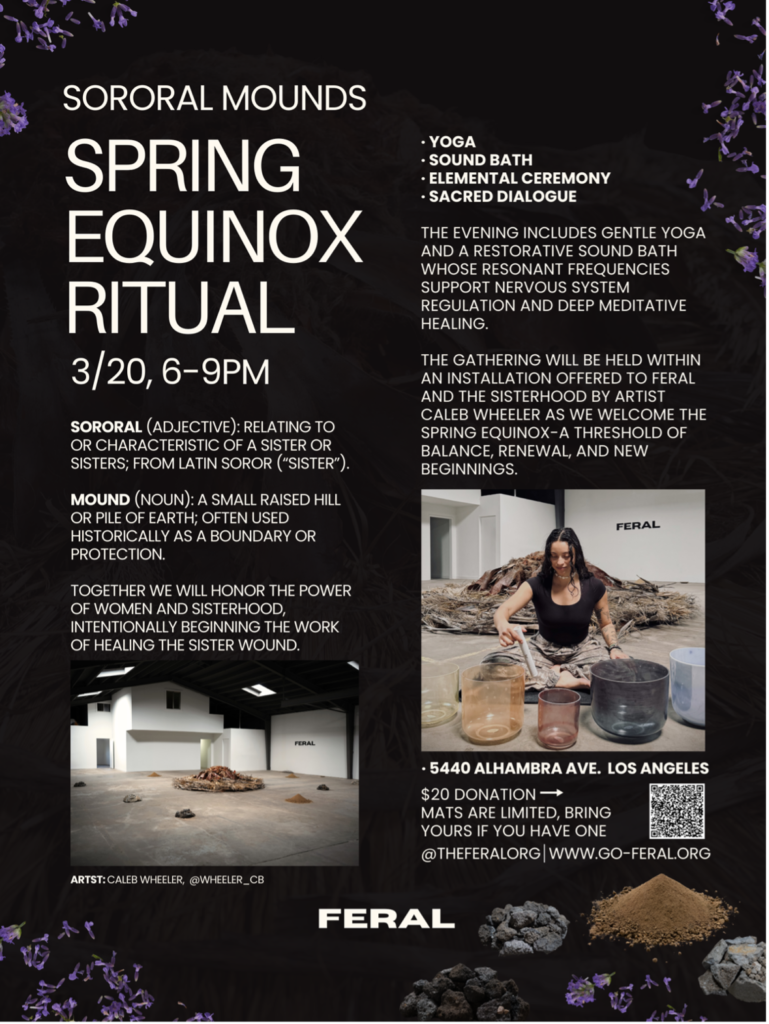
FERAL held an event that celebrated the Spring Equinox on March 20th within Sororal Mounds in Los Angeles with an installation by artist Caleb Wheeler. The goal of this event was to give a safe place for women that experienced abuse in different forms and allow them to immerse themselves in a yoga sessions, restorative bath healing, and to be able to express how they feel without judgement.
“In light of current events coinciding with Women’s History Month and Feral’s powerful rebrand, we need to not only practice a serious reverence for sisterhood but to actively engage in it. This installation provides a sacred space for that,” shares artist Caleb Wheeler.
“It’s also a call for men to step up and help elevate women’s voices. This installation highlights the strength of sisterhood while reflecting Caleb’s ongoing commitment to using his platform and privilege to support women and help create space for our voices to be heard,” adds founder of FERAL Laverne Delgado.
Laverne Questions Below
Interviewer: Can you tell us some insight about FERAL and what you contribute to the organization? What was the original mission, and has it evolved over time?
Laverne: “As the founder of FERAL, I’m proud to share that our organization grew out of the legacy of Freedom and Fashion, where we used fashion and beauty as powerful tools for expression and opportunity. Since 2008, we’ve supported thousands of survivors and their families.
Originally, our mission was to provide resources and creative opportunities for survivors of abuse. Over time, we realized there was a deeper need for spaces where women could reconnect with their instincts, process all emotions without shame, and challenge harmful cultural norms. This understanding, especially in the wake of recent challenges like the California wildfires, inspired us to evolve our mission.
Today, FERAL is dedicated to connecting survivors with resources and healing opportunities that honor the interconnectedness of mind, body, nature, and creative expression. Our work is about returning to what is natural and true, empowering women to embrace every part of themselves, just as nature does.”
Interviewer: Was there a personal experience that shaped the vision behind this organization?
Laverne: “I’m from New Mexico and come from an Indigenous lineage, so my connection to the wild and to nature runs deep in my roots. I’m also an activist and a survivor myself, having faced some very difficult things. In my own journey of healing and creating spaces for others to heal, I recognized that women’s rage, sacred and powerful, is rarely honored, let alone harnessed. Yet, this energy is like fire in nature: undeniable, transformative, and essential for survival and renewal.
For me, learning to move with this energy was crucial to my own healing, and I discovered that so many women long for the chance to do the same. That realization shaped the heart of FERAL: creating spaces where women can embrace every part of themselves, especially the parts that are often suppressed or misunderstood.”
Interviewer: Why was it important to create a space specifically centered around trauma and healing?
Laverne: “Without it, we perish.”
Interviewer: What are some misconceptions people have about trauma and recovery that you hope to challenge?
Laverne: “That healing is this clean, clinical process that fits neatly into a 45-minute therapy session. Healing is wild and deeply intuitive. There’s so much raw power and capacity to heal ourselves from within when we reconnect with our bodies and with nature. It’s not about “fixing” ourselves; it’s about honoring all of our parts and trusting that we already hold what we need to heal.”
Interviewer: FERAL just had an event on March 20th, can you tell us about it and what the organization had to offer for attendees?
Laverne: “On March 20th, FERAL hosted 𝐒𝐎𝐑𝐎𝐑𝐀𝐋 𝐌𝐎𝐔𝐍𝐃𝐒, a FERAL Ritual rooted in rewilding through deep nourishment, honest reflection, deconstruction, and collective care. The word “sororal” speaks to the essence of sisterhood, while “mounds” evoke both the earth and the idea of protection—small hills shaped by time, resilience, and intention.
This offering, created by artist and Feral team member, Caleb Wheeler, for Women’s History Month, was an immersive contemplation on the ecology and resilience of sisterhood. Using reclaimed materials like palm fronds, concrete, loam, and clay, the sculptural arrangement became a living metaphor for how women and survivors of trauma remain defiantly communal, even within social paradigms that try to fracture and divide us.
The event moved beyond performance into real purpose, using sound, movement, and elemental practices to guide us into deeper, more honest conversations, the kind necessary to change our world. We named and tended to the wounds that keep us divided, unpacking patriarchal patterns and privilege, and exploring how these forces shape how we relate to each other and the land.”
Interviewer: Was the event successful and allowed attendees to feel seen and validated?
Laverne: “Unlike ever before.”
Interviewer: What’s next for FERAL in 2026?
Laverne: “Fully embracing the power of ritual, nature, and the pack.
We are on the ascension.”
Caleb Questions Below
Interviewer: Can you tell us more about yourself and what you contributed to the recent event with FERAL?
Caleb: “I’m a freelance film editor and only recently started indulging in an installation art practice. I met Laverne back in 2015 on the set of a documentary and a decade later we’ve developed a lasting friendship through the work we’ve done together inside of her org. Freedom and Fashion was an incredible refuge and resource for survivors and FERAL is now a complete evolution of it, expanding into spaces like nature, wellness, and spirituality. Understanding Laverne’s vision for the rebrand, I saw it as an opportunity to literally build something to commemorate the moment. Sororal Mounds was the result — a large land art installation staged in an El Sereno warehouse used for daily public exhibition as well as a special Spring Equinox event where the FERAL team produced a candle-lit yoga hour, sound bath, and guided elements ritual.”
Interviewer: What does empowerment look like in the context of trauma recovery through art?
Caleb: “Art in any medium is fundamentally representational, and being able to convey trauma and identity through that kind of raw expression is something I’ve seen rehabilitate survivors in real time. It’s a form of control over the narratives they tell themselves or what the world tends to project onto them. The incredible strength and perseverance they hold is so apparent to people like me who humbly participate in FERAL’s work, but they don’t always see it themselves until it’s reflected back in something they’ve personally created. Laverne facilitates spaces where that kind of discovery and ownership takes place.”
Interviewer: How did you decide what to create for the event for attendees?
Caleb: “The idea of communality was the impetus and the theme ultimately became sisterhood and the resilience of that bond. Using materials collected all around the city like concrete fragments and fallen palm tree fronds, I formed and sculpted alters that served as a kind of reintegration metaphor and also functioned as a primal, meditative space where visitors could feel present with the idea that all people, particularly women, are at their most powerful when they commune.”
Interviewer: Are you going to be collabing with FERAL again in the future?
Caleb: “100% I want to continue using both my media vocation and art practice to help build and document for the purposes of raising awareness and healing those most in need under the banner of FERAL’s mission.”